

Why the Subfloor is the Secret to a Quiet, Long-Lasting Laminate Flooring
When you pick out a beautiful new laminate flooring from our Killeen, TX showroom, you’re probably excited about the color, the texture and the way it’ll look in your home.
But at Technique Flooring & Restoration, we know that the most beautiful laminate in the world is only as good as what’s underneath it.
After 39 years of “Flooring Central Texas with Excellence,” we’ve seen how often a “DIY” project goes wrong simply because the subfloor was ignored. If you want your laminate floor to be part of your home for decades, you need to understand the relationship between your new planks and the slab beneath them.
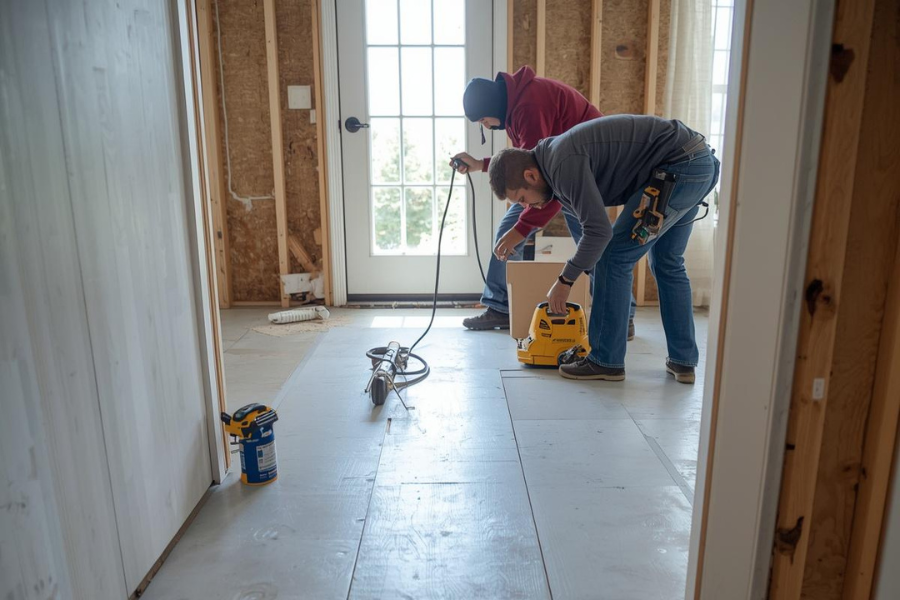
Table of Contents
- Let’s Start with the Basics: Does Laminate Need a Subfloor?
- What is the Subfloor?
- The “Floating” Reality
- How Flat Does Your Laminate’s Subfloor Need to Be? How Flat is “Flat Enough”?
- How to Avoid the “Hollow” Sound
- The Central Texas Subfloor Challenge: Shifting Slabs
- Laminate Flooring Subfloor Preparation Checklist: Before the Planks Go Down
- Find New Laminate Flooring & Laminate Installation Expertise with Technique Flooring & Restoration
- Laminate Subfloor & Installation Frequently Asked Questions (FAQ)
- Let’s Start with the Basics: Does Laminate Need a Subfloor?
Let’s Start with the Basics: Does Laminate Need a Subfloor?
The short answer is: Laminate is a “Floating Floor,” but it always needs a stable subfloor.
What is the Subfloor?
This is the structural foundation of your home—typically a concrete slab (common in Central Texas) or a plywood/OSB framework.
Think of it as the “unsung hero” that provides the backbone for your entire flooring system by supporting the weight of your furniture and family while keeping the finished floor perfectly flat. Because it sits directly on your floor joists or ground-level fill, its quality determines whether your home feels solid and quiet or susceptible to the squeaks, sagging, and moisture traps that can ruin an expensive investment.
The “Floating” Reality:
Unlike tile or traditional hardwood, laminate is not glued or nailed down. It “floats” on top of the subfloor. This means if the subfloor is damp, uneven, or dirty, the entire floor will feel unstable and may eventually fail.
Because the planks rely on a locking mechanism rather than a permanent bond to the slab, any movement in the foundation can cause the joints to stress or separate. Without a perfectly prepared base, you may experience shifting or “bouncing” underfoot, which eventually compromises the structural integrity of your entire flooring system.
The Underlayment Factor:
While you don’t install a new structural subfloor, you almost always need an underlayment. In 2026, many of our high-end laminates come with a pad pre-attached, but for Central Texas homes, we often recommend an additional moisture barrier to protect against slab humidity.
How Flat Does Your Laminate’s Subfloor Need to Be? How Flat is “Flat Enough”?
In the flooring world, we distinguish between “level” (perfectly horizontal) and “flat” (no humps or dips). For laminate, flatness is the priority.
- The Industry Standard: Most manufacturers require the subfloor to be flat within 3/16 of an inch over a 10-foot radius (or 1/8 inch over 6 feet).
Laminate uses a “click-lock” system. If there is a “valley” in your subfloor, the planks will flex every time you step on them. Over time, this stress will snap the locking mechanism, leading to gaps, squeaks, and eventual floor failure.
How to Avoid the “Hollow” Sound:
If you’ve ever walked on a laminate floor that sounded like a drum, it’s likely because there was a gap between the subfloor and the laminate. A perfectly flat subfloor ensures a solid, quiet “thud” that mimics real hardwood.

The Central Texas Subfloor Challenge: Shifting Slabs
Killeen, Fort Cavazos, and Belton are built on “Blackland Prairie” soil, which is notorious for expanding and contracting. This movement often leads to “peaks” (high spots) and “valleys” (low spots) in your concrete slab.
- Checking for Flatness: Our IICRC-certified installers use a long straightedge or a laser level to “map” your room. We look for those hidden dips that the naked eye can’t see.
- The Fix: We use high-quality self-leveling compounds to fill in the valleys and specialized grinders to take down the peaks. This surface prep is what separates a “Best of Central Texas” installation from a weekend DIY job.
Laminate Flooring Subfloor Preparation Checklist: Before the Planks Go Down
Before we install a single piece of your 2026 “Lived-In” laminate, your subfloor must be:
- Clean: Every speck of dust or drywall mud must be scraped away. Even a tiny pebble can cause a “telegraphing” bump in your floor.
- Dry: We use moisture meters to ensure your concrete slab is fully cured and dry. Installing a damp slab is a recipe for mold.
- Solid: Any loose plywood or squeaky boards must be screwed down tight.
Expert Note: We handle everything from the slab up—this includes grinding down high spots, filling low spots, and moisture mitigation. However, we do not perform structural foundation repairs. If your Killeen home has major foundation heaving or structural cracks, those must be repaired by a foundation specialist before we can install your new floor. A beautiful floor cannot fix a broken house!
Find New Laminate Flooring & Laminate Installation Expertise with Technique Flooring & Restoration
A luxury laminate floor is a significant investment in your home’s value. Don’t let a subfloor “shortcut” ruin your 2026 remodel.
At Technique Flooring & Restoration, we bring 39 years of experience to every measurement and every bag of leveler. We understand the science of a flat floor, and we back our precision work with a 100% satisfaction guarantee.
Trust the team voted the Best of Central Texas for 10 years straight to ensure your floor has the perfect foundation to last a lifetime.
Call or stop by our flooring store today!
Service Areas: Bell County, Coryell County, Lampasas County, Williamson County, and Burnet County
About Technique Flooring & Restoration
At Technique Flooring & Restoration, our mission is “To provide our customers with astounding cleaning, flooring, and restoration solutions.” For over 35 years, we have been the premier authority for residential and commercial flooring in Central Texas. As an IICRC-certified company, we prioritize reputation and excellence, backing all our work with a 100% satisfaction guarantee.
Laminate Subfloor & Installation Frequently Asked Questions (FAQ)
Q: Can I use extra underlayment to “fix” an unlevel floor?
A: No! This is a common mistake. Extra padding makes the floor too “spongy,” which puts even more stress on the locking joints. You must level the subfloor itself, not the pad.
Q: How much does professional leveling cost?
A: It depends on the severity of the dips and humps. We provide a detailed breakdown in our FREE estimate so there are no surprises on installation day.
Q: Can laminate be installed over old tile?
A: Yes, provided the tile is solid and level. We often have to “skim coat” the grout lines to ensure the surface is perfectly flat.